
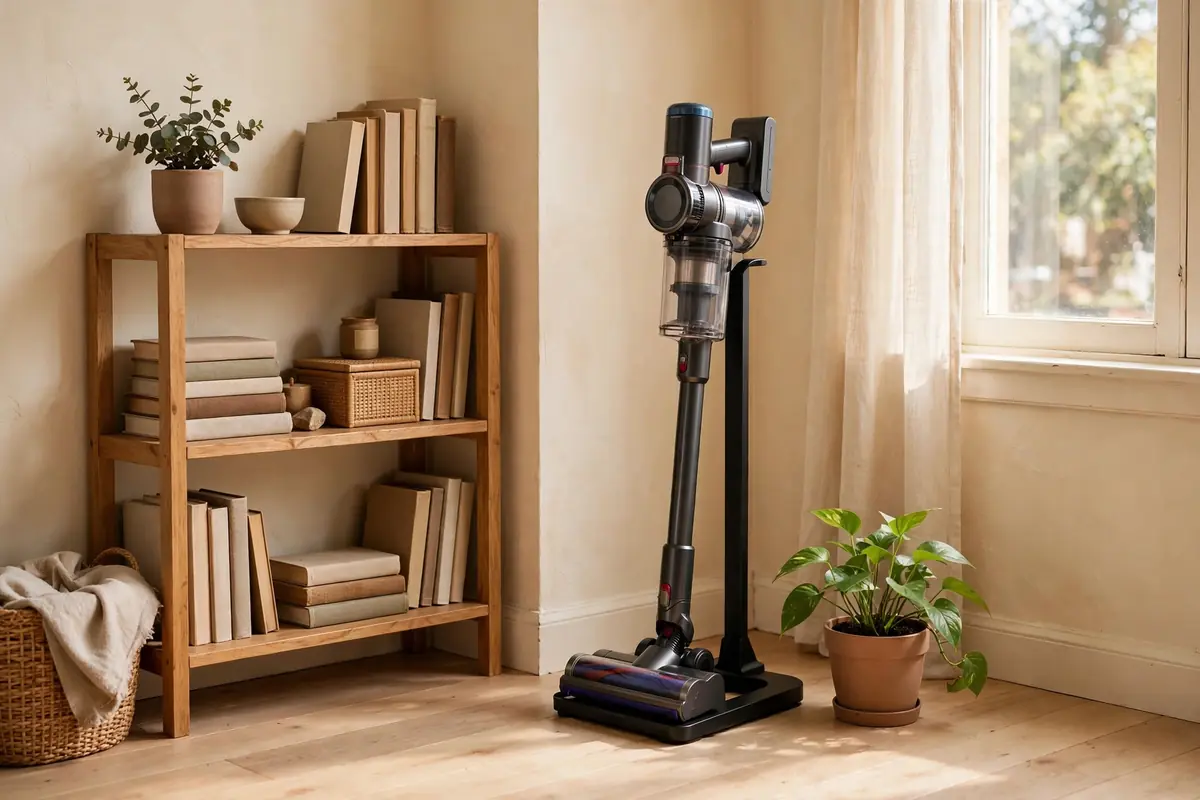
A vacuum cleaner can be surprisingly difficult to store in a small apartment. It is often too tall for a standard cabinet, too bulky for a drawer, and too awkward to leave in a corner without making the room feel cluttered.
If your apartment has no utility closet, you do not necessarily need to buy a large storage unit. The best solution is to match your vacuum’s size, shape, and charging requirements to a spot you already have.
This guide covers 10 practical vacuum storage ideas for small apartments, including options for cordless stick vacuums, upright models, robot vacuums, and handheld cleaners. You will also learn how to measure your available space, protect your rental finishes, and avoid storage arrangements that interfere with charging or everyday movement.
Quick Answer: Where Should You Store a Vacuum in a Small Apartment?
The best location depends on the type of vacuum you own and whether it needs a charging dock.
- Stick or cordless vacuum: Try a floor-supported stand, a suitable storage nook, or a manufacturer-approved wall mount.
- Upright vacuum: Look for a stable closet corner, a sufficiently large cabinet, or a designated space against a wall.
- Robot vacuum: Choose a suitable dock location with the clearances required by your specific model.
- Handheld vacuum: Use a shelf, drawer, or cleaning caddy if the vacuum and its battery-storage requirements allow it.
Before choosing a location, check the vacuum’s full stored dimensions, including its floor head, handle, accessories, and charging dock. Make sure the vacuum can be removed easily without blocking a doorway or walkway.
The goal is simple: give your vacuum a designated home that makes it easy to retrieve and put away.
Why Vacuum Storage Is Difficult in Small Apartments
In a larger house, a vacuum may fit in a garage, utility room, or dedicated cleaning closet. In an apartment, every corner may already serve a purpose.
Four common problems make vacuum storage especially challenging.
Limited floor space: A bulky vacuum can interfere with furniture placement or make a narrow hallway feel crowded.
Rental restrictions: Drilling holes for a wall mount may not be permitted under your lease or building rules.
Visible clutter: A vacuum left beside the sofa or bedroom door can make an otherwise tidy room look unfinished.
Charging requirements: Some cordless and robot vacuums need a dedicated dock or a specific charging arrangement. An available corner is not automatically a suitable charging location.
The solution is to measure first, identify the right storage method, and choose the least complicated arrangement that works safely.
Before You Buy Anything: The 3-Minute Vacuum Fit Test
A storage stand or cabinet can look perfect online and still fail to fit your actual vacuum. Use this quick measurement process before spending money.
Step 1: Measure Your Vacuum
Measure the vacuum in the position in which you plan to store it. Record the following:
- Overall height, including the handle or folded components.
- Widest point, including the floor-cleaning head.
- Depth from front to back.
- Space required for any wall mount, floor stand, or charging dock.
- Extra room needed to lift or remove the vacuum comfortably.
If your vacuum has detachable accessories, decide where those will live too.
Step 2: Measure the Storage Spot
Measure the available height, width, and depth of the proposed location. For a narrow gap, check that the floor head and handle can pass through without getting caught. For a cabinet, account for the door, shelves, and any internal hinges that reduce usable space. For a doorway, open the door fully and confirm that the vacuum will not interfere with its movement.
Step 3: Test the Complete Setup
If possible, temporarily position the vacuum in the proposed spot. Check whether you can remove it, return it, and connect its charger without moving furniture or creating a tripping hazard.
Your measurement rule: Use the dimensions of your actual vacuum and storage equipment instead of relying on generic measurements. Models within the same category can have very different shapes.
The Retrieval Test Most Vacuum Storage Photos Miss
A vacuum can fit in a gap and still be frustrating to use. Before choosing its home, check three separate shapes: the stored machine, the path needed to remove it, and the charging or servicing space specified by its manufacturer.
Illustrative example: an upright vacuum is 12 inches wide at the floor head and a cupboard is 13 inches wide inside. The cupboard may still be unsuitable if the door opening narrows to 11 inches or the vacuum must tilt to clear a shelf. Use a cardboard template of the widest point or try the machine in place before buying a cabinet.
Choose by model: a cordless stick vacuum may suit a compatible manufacturer-approved docking setup or stable stand. An upright vacuum needs a stable supported position. A robot vacuum needs the front and side approach clearances stated in its exact manual. A handheld model may fit on an accessible shelf, subject to charging guidance.
Do not place charging docks under dripping pipes, bury electrical cables under rugs or assume every battery can safely charge inside a closed cupboard. The best spot is one you can use without moving other furniture every time. Plan the rest of your weekly routine with the Sunday Reset Builder.
Is a vacuum that physically fits behind a door automatically safe to store there?
No. It must remain stable, allow the door to open and avoid damage to cables, handles and the wall. Charging models also need their manufacturer’s docking and electrical clearances.

Stick and Cordless Vacuum Storage Ideas
Stick vacuums are often easier to accommodate than bulky upright models, but their lightweight design does not mean every hook or stand is suitable.
1. Use a Freestanding Vacuum Stand
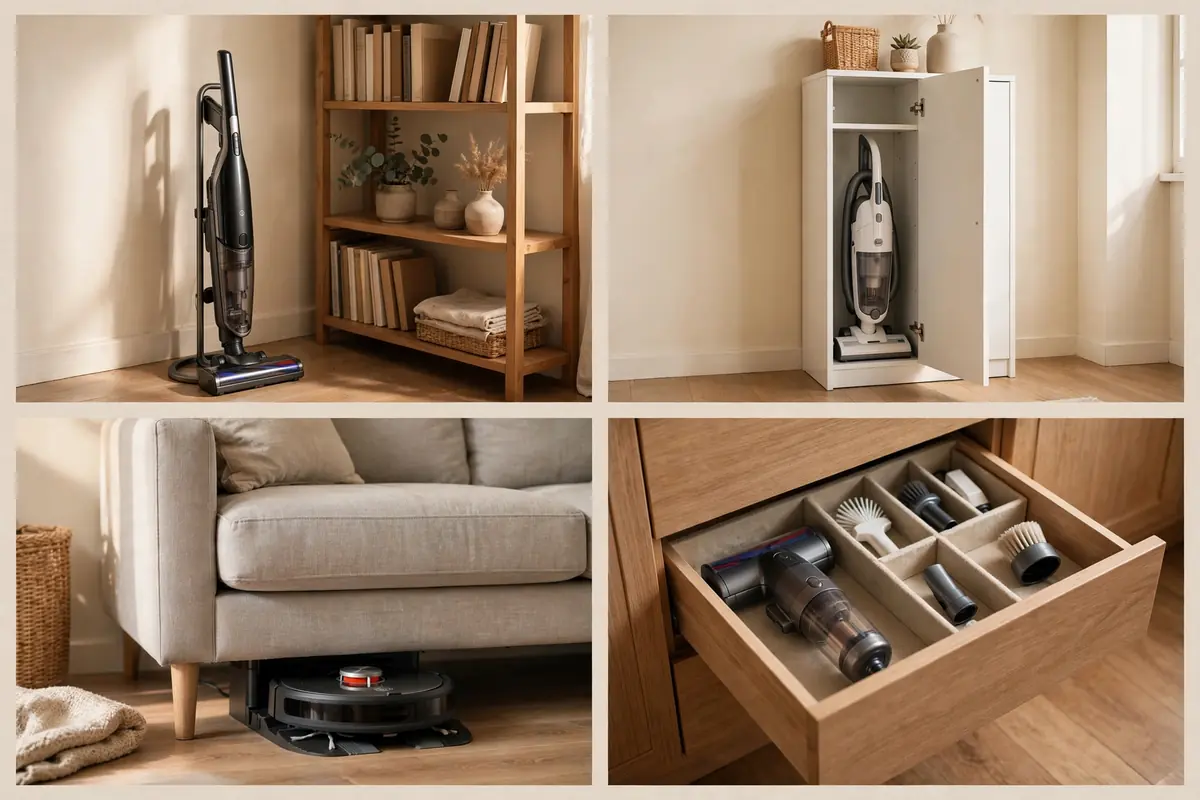
A freestanding vacuum stand is one of the most practical options for renters who cannot install a wall mount.
The stand supports the vacuum from the floor and can often be moved when you rearrange your furniture. Depending on the design, it may also provide a place for accessories or a compatible charging attachment.
Where it works best: A bedroom corner, the side of a bookshelf, or a designated cleaning area.
Before buying: Check that the stand is compatible with your vacuum’s model and floor head. Confirm that the base is stable and that the complete setup fits the available footprint.
Do not assume that a universal stand supports every vacuum or charging arrangement.
2. Use a Suitable Behind-the-Door Storage Solution
The space behind a door may offer useful storage without taking up additional floor area.
For a lightweight stick vacuum, a purpose-built over-door holder may work if it is compatible with the vacuum and door.
However, not every over-door hook is suitable for a vacuum. Check the holder’s weight rating, the vacuum’s balance, the door’s construction, and whether the door can close fully.
Avoid arrangements that make the vacuum likely to fall when the door moves. If the holder is not specifically suitable for your vacuum, choose a floor-supported stand instead.
Best for: Apartments where floor space is especially limited and the door can accommodate a suitable holder. For more behind-the-door ideas, see our small apartment entryway ideas when you don’t have a closet.
3. Store the Vacuum in a Narrow Furniture Gap
A narrow gap beside a bookshelf, wardrobe, or other stable piece of furniture may be enough for a slim vacuum.
This can be a useful way to use an awkward space without adding another storage unit.
Measure the widest part of the vacuum, especially the floor head, before deciding that the gap will work.
Keep the vacuum accessible and make sure it cannot fall into the gap. Avoid wedging it tightly between furniture or placing it where it could obstruct ventilation, appliance access, or a walkway.
If the vacuum needs a charging dock, check that the dock and cable can also fit safely.
4. Use the Manufacturer’s Wall Mount
If your vacuum came with a wall mount, installing it according to the manufacturer’s instructions can keep the floor clear and provide a dedicated place for the vacuum.
This option may be especially useful in a laundry area, utility nook, or suitable section of a wall.
For renters, check your lease and obtain permission where required before drilling. Use the specified mounting hardware and suitable wall fixings for the wall type.
Do not substitute an ordinary hook, tension rod, or improvised hanger for a mount designed to support your vacuum.
If drilling is not an option, a compatible freestanding stand is usually a simpler alternative.
Upright Vacuum Storage Ideas
Upright vacuums usually require more floor space than stick models. Their weight and shape also make stability more important.
5. Choose a Tall, Slim Storage Cabinet
A tall cabinet can conceal an upright vacuum and keep other cleaning supplies in one place.
Before buying a cabinet, compare its usable interior dimensions with the vacuum’s actual height, width, and depth. Allow room for the handle, cord, hose, and accessories.
Check the door opening and make sure the vacuum can be removed without tilting it awkwardly.
Renter consideration: A tall cabinet may need an anti-tip restraint. Follow the furniture manufacturer’s safety instructions and check your lease before installing any wall anchors. The U.S. Consumer Product Safety Commission recommends securing top-heavy furniture to reduce tip-over risks.
If you cannot safely accommodate the required restraint, consider a lower, more stable storage solution.
6. Create a Designated Hallway or Room Corner
If you have no closet, a corner beside a wall may provide enough space for your upright vacuum.
Choose a spot that does not interfere with doors, escape routes, or everyday movement. Keep the vacuum stable and position its cord so nobody can trip over it.
If you want to conceal the vacuum, consider a suitable freestanding screen or another non-permanent visual divider. Avoid adding anything that narrows an already tight hallway.
This approach works best when the vacuum has a clear, predictable place to return to after each use.
7. Make Room in an Existing Closet
Even a small bedroom or entryway closet may have a usable corner once you reorganize its contents.
Start by removing items you no longer need and grouping the remaining belongings by purpose. Move lightweight, infrequently used items to an appropriate upper shelf if the shelf is designed to support them.
Measure the newly available space before moving the vacuum inside.
Keep the vacuum accessible rather than stacking heavy items around it. If you store cleaning products nearby, keep them closed, upright, and away from children and pets.
For more ways to make a reach-in closet work harder, see our small closet storage system for renters.
Robot Vacuum Storage Ideas
Robot vacuums are different from upright and stick models because their dock is part of the storage plan. A spot that hides the dock beautifully may prevent the robot from returning to it.
8. Place the Dock Under Suitable Furniture
The space beneath a sofa, bed, or console table may seem ideal for hiding a robot vacuum’s dock.
Before using it, check the height of the furniture, the dock’s dimensions, the robot’s approach path, and the manufacturer’s required clearance.
Some robot vacuums need substantial open space in front of and beside the dock. For example, iRobot specifies more than 0.5 metres on each side and more than 1.2 metres in front for certain Roomba AutoEmpty docks. Requirements vary by model, so use your own product manual rather than applying these measurements to every robot.
Make sure the dock can remain in its recommended position and that the robot can enter and leave without hitting furniture.
If the available space does not meet the manufacturer’s requirements, choose another location instead of forcing the dock underneath the furniture.
9. Give the Dock a Dedicated Open Spot
A low, open area beside a media console or along a wall may be a better choice than hiding the dock.
The ideal location should have:
- A stable, level surface suitable for the dock.
- The clearances specified by the manufacturer.
- Access to the required power outlet.
- A clear path for the robot to enter and leave.
- Protection from excessive heat, direct sunlight, and moisture where the manufacturer advises it.
Do not assume a dock can be placed inside a closed cabinet or on a shelf. Some models require floor placement and open space around the charging base.
Check your robot’s manual before moving the dock. After relocating it, confirm that the robot can return and charge successfully.
Handheld Vacuum Storage Ideas
10. Use a Drawer, Shelf, or Cleaning Caddy
A handheld vacuum is usually easier to store because it occupies less space than a full-size model.
Depending on its dimensions and charging requirements, you may be able to keep it in a drawer, on a shelf, or inside a dedicated cleaning caddy.
Choose a location where you can remove the vacuum easily without disturbing other items. Store detachable tools together so you do not have to search for them when you need to clean a small spill.
If the vacuum is cordless, follow the manufacturer’s battery and charging instructions. Do not store or charge it in a damp location or near a heat source.
For a coordinated storage area, see our guide to storing cleaning supplies in a small apartment without a utility closet.
Create a Small Apartment Cleaning Station
If you own a vacuum, broom, microfiber cloths, and several cleaning products, giving them one designated home can make your apartment easier to maintain.
You do not need a separate utility closet. A suitable corner, stable stand, or cabinet may be enough.
Start by grouping the items you use regularly:
- Vacuum and compatible accessories.
- Cleaning cloths and dusting tools.
- Broom or mop, if there is room.
- Cleaning products stored securely in their original containers.
- Replacement bags, filters, or other model-specific supplies.
Keep damp cleaning tools separate from electrical equipment. Avoid storing products where they can leak onto the vacuum, charger, or battery.
Choose a location that keeps the vacuum accessible while preserving clear walkways. If a storage station makes it harder to move around the apartment, reduce the number of items in it.
Vacuum Storage Mistakes to Avoid
A storage spot should protect the vacuum and make it easy to use. Avoid these common mistakes.
Storing a Vacuum in a Damp Bathroom or Balcony
Bathrooms can be humid, and balconies may expose a vacuum to rain, moisture, dust, and temperature changes.
For cordless models, battery storage conditions are particularly important. Dyson, for example, advises storing its cordless vacuums at room temperature and away from direct sunlight and heat sources. Other models may have different requirements.
Indoor storage in a dry, suitable location is generally preferable. Follow your own manufacturer’s guidance.
Using a Hook or Stand Without Checking Its Rating
A hook that holds a coat may not be appropriate for a vacuum. Consider the complete load, the holder’s rating, the mounting surface, and how the vacuum’s weight is distributed.
Avoid improvised tension-rod and S-hook arrangements unless the equipment is specifically designed and rated for the application.
A compatible, stable floor stand is a better default when you are unsure.
Blocking Doors and Walkways
A vacuum stored in a hallway can become a trip hazard if it protrudes into the walking path.
Check door movement, furniture access, and the route through the apartment. Keep cords out of walkways and return the vacuum to its designated place after use.
Ignoring Cord and Charging Requirements
For corded models, follow the manufacturer’s cord-storage instructions and avoid sharp bends, pinching, or damaged insulation.
For cordless models, use the recommended charger and compatible dock. Keep electrical connections away from moisture and follow the manufacturer’s charging and battery-storage guidance.
Do not improvise charging setups simply to hide the vacuum.
Buying Storage Furniture Before Measuring
A cabinet or stand can consume valuable floor space and still fail to fit the vacuum.
Measure both the vacuum and the proposed storage area first. Account for the floor head, handle, charging dock, accessories, door swing, and the space needed to remove the vacuum.
A simple measurement check is usually cheaper than buying the wrong organizer.
Frequently Asked Questions
Where should I store a vacuum if I have no closet?
Start with a suitable floor-supported stand, a stable corner, or a compatible cabinet. For a handheld vacuum, a shelf or drawer may work. For a robot vacuum, choose a location that meets the specific dock’s clearance and charging requirements.
The best option is the one that fits your equipment without blocking a walkway or creating a stability problem.
Can I store a cordless vacuum without drilling into the wall?
Yes. A compatible freestanding stand is often a practical option. You can also use an existing closet corner or a suitable storage nook if the vacuum can stand securely and its charging arrangement is supported.
Do not use an ordinary hook or improvised hanger unless it is designed for the vacuum’s weight and shape.
Can I put a robot vacuum dock under a sofa?
Sometimes, but not every model supports this placement. Check the dock’s height, the robot’s approach path, and the manufacturer’s required clearance. Some docks need a large open area and will not work reliably beneath low furniture.
Is it safe to store a vacuum in a tall cabinet?
It can be suitable if the cabinet has enough usable space, remains stable, and allows easy access. Follow the furniture manufacturer’s anti-tip guidance, especially if children may be present. Check your lease before installing wall anchors.
Should I store cleaning supplies beside my vacuum?
You can keep them in the same designated area, provided they are stored securely and do not leak onto electrical equipment. Keep cleaning products in their original containers and away from children and pets.
How do I know if a vacuum storage stand will fit?
Measure the vacuum’s height, width, and depth in its stored position. Then check the stand’s compatible models, base dimensions, support points, and any charging-dock requirements. Do not rely on the vacuum body width alone; the floor head may be wider.
The Bottom Line
Finding a place for a vacuum in a small apartment without a closet is mainly a matter of matching the storage solution to your equipment and available space.
A freestanding stand can work well for many stick vacuums. Upright models usually need a stable floor area or a cabinet with suitable interior dimensions. Robot vacuums need a dock location that meets their specific clearance requirements, while handheld models may fit on a shelf or in a drawer.
Measure before buying anything, follow the manufacturer’s storage and charging instructions, and keep doors and walkways clear.
You do not need a dedicated utility closet to keep your vacuum organized. You need a safe, accessible place that fits your apartment and makes putting the vacuum away part of your normal routine.
Related Small-Space Guides
- How to Store Cleaning Supplies in a Small Apartment Without a Utility Closet
- Small Closet Storage for Renters: A 4-Zone Reach-In Closet System
- Small Apartment Entryway Ideas When You Don’t Have a Closet
Sources and Further Reading
- iRobot: Where to Place the Dock
- Dyson: Cordless Vacuum Battery Care
- U.S. Consumer Product Safety Commission: Anchor It! Furniture Safety