
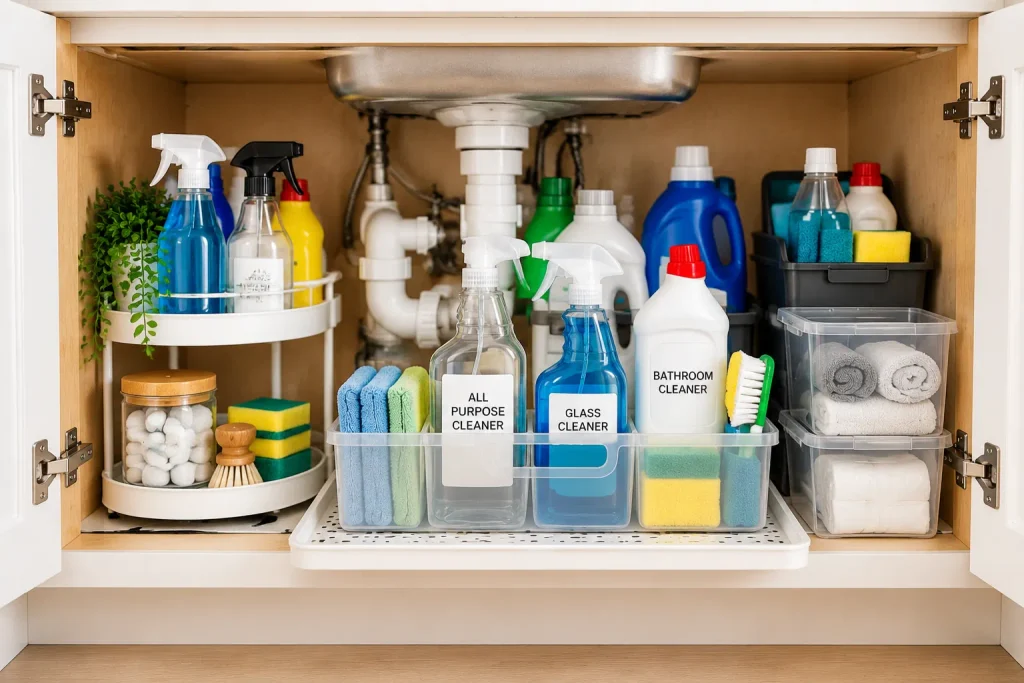
A spray bottle under the bathroom sink, a broom beside the fridge, and a vacuum with no clear home are common storage problems in compact rentals.
Before buying organizers, take inventory of the products and tools you already own. Identify a secure location for cleaning products, a portable caddy for everyday tasks, and a separate spot for larger equipment such as a mop, broom, or vacuum.
- A suitable place for cleaning products
- A portable caddy for everyday cleaning
- A separate storage spot for larger tools
A practical storage system starts with the space you have and the items you actually use—not the number of organizers you buy.
Start With What You Already Own
Before buying bins and organizers, check your current supplies. Separate everything into:
Regular Use — Products you use every week.
Occasional Use — Special cleaners used less frequently.
Duplicates — Extra bottles or products you already have.
You do not need a separate cleaner for every task. Keep the products you use regularly and store occasional-use items separately.
Store Cleaning Products Safely
- Keep products in their original, clearly labelled containers.
- Store containers upright and tightly closed.
- Never mix cleaning products with one another.
- In particular, never mix bleach with ammonia, vinegar, or acidic cleaners.
- Keep chemicals away from food, children, and pets.
- Use a locked or otherwise inaccessible cabinet where children or pets may reach the storage area.
- Always follow the manufacturer’s storage and ventilation instructions.
For US readers, Poison Help is available at 1-800-222-1222.
Avoid moving chemicals into unlabelled bottles. Always check product labels for storage instructions.
Measure First: The 5 Numbers That Decide What Fits
Most under-sink storage fails for one reason: the organizer was bought before the cabinet was measured. Take these five numbers with a tape measure and write them in the free planner at the end of this article before you buy anything.
- Inside width — wall to wall, at the narrowest point (pipes and hinges eat into it).
- Inside height — cabinet floor to the underside of the sink bowl or pipes, at the spot the organizer will sit.
- Inside depth — back wall to the inside of the closed door.
- Door clearance — how far the door swings, and whether a tall bottle or caddy handle blocks it closing.
- Pipe position — where the drain and supply pipes sit, and where the shut-off valves are. Nothing you install should block them.
Measure twice: once with the cabinet empty, once with your tallest bottle standing in place. If a two-tier shelf or turntable is on your list, measure your tallest bottle first — standard spray bottles are often 10–12 inches tall, and that height, not the shelf’s footprint, is what usually does not fit.
Typical Cabinet Sizes (So You Know What “Standard” Means)
These are typical US stock sizes, not a promise about your cabinet. Use them to shortlist organizers, then confirm against your own five numbers above. If your cabinet is older, custom, or non-US, your numbers will differ — and your own measurements win.
| Cabinet | Typical height | Typical depth | Common widths |
|---|---|---|---|
| Kitchen sink base | 34.5″ (36″ with countertop) | 24″ | 30″, 33″, 36″ |
| Bathroom vanity | 30–32″ traditional; 34–36″ comfort height | 21″ | 24″, 30″, 36″, 48″ (single sink) |
What this means in practice:
- Kitchen sink base (24″ deep): the deepest under-sink space in most apartments. A caddy plus a small bin usually fit side by side around the pipes. Tall bottles normally fit standing up — check the height under the sink bowl, not the cabinet’s outside height.
- Bathroom vanity (21″ deep): noticeably shallower. A kitchen-sized caddy often sticks out or stops the door closing. Shorter, narrower organizers work better here, and the door swing matters more because the cabinet is smaller.
- Widths are nominal, not usable space: a cabinet labelled 30″ wide does not give you 30″ of clear interior width. Hinges, the door frame, and pipes take some of it. Measure the clear space, not the label.
Under-Sink Storage: The Best Starting Point
An under-sink cabinet can be convenient when it is dry, secure, and easy to inspect for leaks.
Use: Small cleaning caddy
Keep:
- Multi-surface cleaner
- Cloths
- Sponges
- Everyday products
Backup storage: Keep less-used items separately.
Remember: Do not block pipes, valves, or areas needed for maintenance.
For a complete under-sink system, see Under-Sink Organization for Small Rental Kitchens: Practical Ideas Around Pipes.
What Actually Fits Under a Kitchen Sink
Work around the pipes, not through them. In a typical kitchen sink base, the drain sits in the middle and the supply pipes and valves sit to one side. That leaves two usable zones: a wider zone on one side of the drain, and a narrower strip on the other.
- Wider zone: your caddy, or a small bin with your everyday bottles standing upright.
- Narrower strip: cloths, sponges, gloves, or a slim bin — things you can pull out without moving the pipes.
- In front of the pipes: leave clear. This is where leaks show first, and where you need to reach the shut-off valves fast.
- Above the pipes: usually wasted space. A small shelf that sits over the drain pipe can hold light items, but only if it clears the pipes and still lets you see and reach the valves.
If only one side of the drain is usable in your cabinet, that is normal — plan for one zone, not two, and keep the rest of your supplies in backup storage.
What Actually Fits Under a Bathroom Sink
A bathroom vanity gives you less depth (typically 21″ instead of 24″) and often less width, so the same setup from the kitchen will not transfer as-is.
- Use a shorter caddy than the kitchen one, or a small bin that fits the clear width with the door closed.
- Keep only the daily bathroom cleaners here: toilet cleaner, bathroom spray, cloths. Everything else belongs in backup storage.
- Tall bottles are the usual problem. Measure the height under the basin before buying a two-tier organizer — if your tallest bottle does not clear the shelf, the second tier is unusable.
- If the cabinet is damp or has had a leak, do not store products there until it is dry and the leak is fixed. Damp plus chemicals plus a closed door is a bad combination.
Use a Cleaning Caddy System
A portable caddy helps you clean room by room without carrying multiple bottles. A good caddy should contain:
- Daily cleaning products
- Microfiber cloths
- Small brushes
- Gloves
Do not overload it. The goal is convenience, not carrying your entire cleaning collection.
Three Caddies, Not One Big One
One caddy for the whole apartment sounds tidy, but it ends up either too heavy to carry or missing the one bottle you need. Three small, room-specific caddies work better in a small space:
- Kitchen caddy: multi-surface cleaner, dish soap, cloths, sponge. Lives under the kitchen sink.
- Bathroom caddy: bathroom spray, toilet cleaner, cloths, gloves. Lives under the bathroom sink.
- Laundry / general caddy (if you have the space): stain remover, laundry supplies, duster. Lives on a laundry shelf or in backup storage.
Each caddy holds only what that room needs, so none of them gets overloaded — and you are not carrying kitchen cleaner into the bathroom every time. If you only have room for one caddy, make it the kitchen one and keep a small basket for the bathroom instead.
Renter-Friendly Organizers That Fit (and the Fit Check for Each)
No drilling, no permanent changes. Before buying any of these, run its fit check against your five numbers.
- Stackable bins: cheap and flexible. Fit check: bin height plus a bottle standing inside it must clear the sink bowl or pipes.
- Turntable (lazy Susan): good for reaching bottles at the back. Fit check: its diameter must fit the depth of the cabinet with the door closed — a turntable that fits a 24″ kitchen cabinet often does not fit a 21″ vanity.
- Tension rod: spans the cabinet to hang spray bottles by their triggers, freeing the floor. Fit check: the rod must sit above the pipes with bottles hanging clear of the valves, and the cabinet walls must be solid enough to hold it.
- Over-door holder: for the cabinet door itself. Fit check: door thickness, the holder’s hooks, and whether the door still closes with bottles in it. Check your lease first — some rentals restrict over-door hardware.
- Narrow rolling cart: for the gap beside the fridge or between cabinets. Fit check: gap width, cart height under the countertop, and whether it rolls out without hitting a door or appliance.
If an organizer fails its fit check, skip it. A cheap organizer that does not fit becomes another problem — and another thing to store.
What NOT to Store Under the Sink
- Anything you cannot reach in a hurry: shut-off valves must stay clear, always.
- Bleach and ammonia-based cleaners together: never store them where a leak or a knocked-over bottle could mix them. Keep them apart, upright, and tightly closed.
- Aerosols near heat: not under a sink next to a dishwasher or hot-water pipes that run hot.
- Products in unlabelled bottles: if you cannot read what it is, you cannot store it safely.
- Anything in a damp or leaking cabinet: fix the leak and dry the cabinet first. Tell your landlord about a leak — it is their pipe, and a small leak becomes a big repair if it is hidden behind bottles.

Where To Store Mop, Broom and Vacuum
Large cleaning tools need their own space.
Over Door Storage
Good for: broom, mop, duster.
Check: door thickness, weight limit, door closing space.
Freestanding Holder
Good when: you have a small corner, you want no installation.
Vacuum Storage
Keep: stable, accessible, away from walking paths. Follow manufacturer charging instructions for cordless models.
For more vacuum storage ideas, see Where to Store a Vacuum in a Small Apartment: 10 Ideas.
Small Apartment Storage Rule
Before buying any organizer: Measure first.
Check: width, height, depth, door clearance, pipe location.
A cheap organizer that does not fit becomes another problem.
Free Printable: Cleaning Supplies Storage Planner
Plan Your Cleaning Storage Before Buying Organizers
Download our free Cleaning Supplies Storage Planner. Use it to:
✓ Measure under-sink space
✓ Plan bathroom storage
✓ Organize laundry supplies
✓ Decide where mop, broom and vacuum belong
(The planner includes sections for under sink, bathroom, laundry area, tools & large items, measurement areas, storage map, and a quick checklist.)
FAQ
Where should I store cleaning supplies in a small apartment?
Choose a secure storage area for products, a portable caddy for daily cleaning, and a separate location for large tools.
Can I store cleaning supplies under the sink?
Yes, if the area is dry, secure, and kept out of reach of children and pets.
How do I store a mop without a closet?
Use a suitable over-door holder, freestanding stand, or another stable location that keeps walking areas clear.
How do I measure my under-sink cabinet?
Measure inside width, inside height to the sink bowl or pipes, inside depth, door clearance, and pipe position. Write all five in the planner before buying an organizer — the label width on the cabinet is not the usable width.
What size caddy fits under a bathroom sink?
Smaller than the kitchen one. A typical bathroom vanity is only about 21″ deep, so measure the clear width and depth with the door closed, and check that your tallest bottle fits standing up before you buy.
Can I store bleach under the sink?
Only if the cabinet is dry, the bottle is upright, tightly closed, in its original labelled container, and stored apart from ammonia-based cleaners. If the cabinet leaks or is damp, or children or pets can reach it, store it elsewhere in a locked or inaccessible spot.