

Your kitchen counter is already full, but that doesn’t mean you have to give up on a dedicated coffee station. You can move coffee-making supplies to a rolling cart, a tray on a dining table, a narrow console, or a cabinet shelf used for storage.
These 15 small apartment coffee station ideas focus on reclaiming kitchen counter space without permanent drilling. Some setups use existing furniture; others rely on freestanding or removable organizers. Choose an arrangement that suits your apartment, your coffee equipment, and the clearances required by its manufacturer.
Before You Set Up: Measurements and Safety
Coffee machines produce heat, and some release steam. Before choosing a location, check the instructions for your exact coffee maker, espresso machine, or kettle. Dimensions, ventilation requirements, and access needed to open lids or remove reservoirs vary by model.
Measure four things before buying organizers:
- Footprint: Measure the machine’s width and depth, plus room for a mug and the movements needed to brew.
- Opening clearance: Check the space needed to open the lid, remove the water reservoir, add coffee, and clean the machine.
- Heat and steam clearance: Follow the manufacturer’s instructions for space above and around the appliance. Do not assume one clearance measurement works for every machine.
- Outlet and cord access: Keep cords away from sinks, drips, walkways, and cart wheels. Avoid placing power strips where spills can reach them.
Never operate a coffee machine inside a closed cabinet unless the manufacturer explicitly permits that use and all required clearances are met. A cabinet can be used for storage, but you may need to remove the machine before brewing.
Treat dimensions mentioned in this guide as planning examples rather than guaranteed fits. Measure your own equipment and furniture before purchasing.
Where Can You Brew, Not Just Store, Coffee?
A cart or cupboard may hold a coffee machine, but storage space is not always a safe place to operate it. Before selecting a station, inspect the equipment’s manual for heat, steam, water and electrical clearances.
| Equipment | Potential storage approach | What to verify before use |
|---|---|---|
| Compact pod brewer | Freestanding cart or stable tabletop | Lid/reservoir opening and safe power access |
| Drip brewer | Suitable shelf for storage | Heat/steam clearance and safe brewing surface |
| Kettle | Secure dry cupboard when unplugged | Stable counter for operation away from splashes |
| Manual brewer | Compact tray or cabinet | Stable surface and safe handling of hot water |
Illustrative renter scenario: a studio has no free kitchen counter but a stable dining table near a suitable outlet. Store the unplugged machine and supplies on a shelf or cart; move the machine to the table to brew only if its manual allows that setup and the surface is protected appropriately. Return it after cooling and cleaning. This may be safer than operating it under a low cabinet or on a narrow unsupported shelf.
A coffee station should never require trailing cords across a walkway or operating hot appliances inside closed furniture. If you are buying a cart or storage bin for supplies, check the fit first with the Bin-Fit Calculator. For the counter space you do have, our kitchen counter organization guide shows how to protect one uninterrupted prep zone, and backup coffee supplies can live with your dry goods — see our no-pantry storage guide.
Quick Comparison: Which Coffee Station Fits Your Space?
| Setup | Space to plan for | Drilling | Best for | Main limitation |
|---|---|---|---|---|
| Rolling cart | Cart footprint and a parking spot | No | Renters and flexible rooms | Needs floor space and outlet access |
| Tray station | A stable table or desk surface | No | Studios and shared kitchens | Must be set up and put away |
| Console table | Table depth and walking clearance | No | Hallways and living rooms | Uses floor space |
| Cabinet or pantry shelf | Usable shelf depth and opening clearance | No | Hiding supplies | Machine may need to be removed for brewing |
| Bookshelf or nightstand | Suitable shelf size and height | No | Bedrooms and multi-use rooms | Shelf strength and opening height vary |

Rolling and Mobile Setups
1. Use a Three-Tier Rolling Cart
A three-tier utility cart can hold a compact coffee maker on a stable top, mugs and daily supplies on the middle shelf, and lighter backup items below. It gives your coffee equipment a dedicated home without permanently taking over the kitchen counter.
Measure the cart’s actual top surface and confirm it can safely support the appliance. Choose a level, stable cart with a suitable load rating, keep heavier supplies on lower shelves, and lock the wheels before brewing. Keep the cord clear of wheels and walkways.
Best for: renters, studio apartments, and rooms where the coffee station needs to move occasionally.
2. Turn a Bar Cart or Kitchen Trolley into a Coffee Bar
A bar cart or kitchen trolley offers more room for coffee preparation, mugs, jars, and accessories. It can be styled as part of the living room or dining area and moved when the space is needed for another purpose.
Before using one, check the top’s load capacity, the cart’s stability, and whether its wheels lock securely. Position it within safe reach of an outlet without routing the cord across a walkway. If your machine is heavy or releases strong steam, choose a more stable surface with the clearances required by its manual.
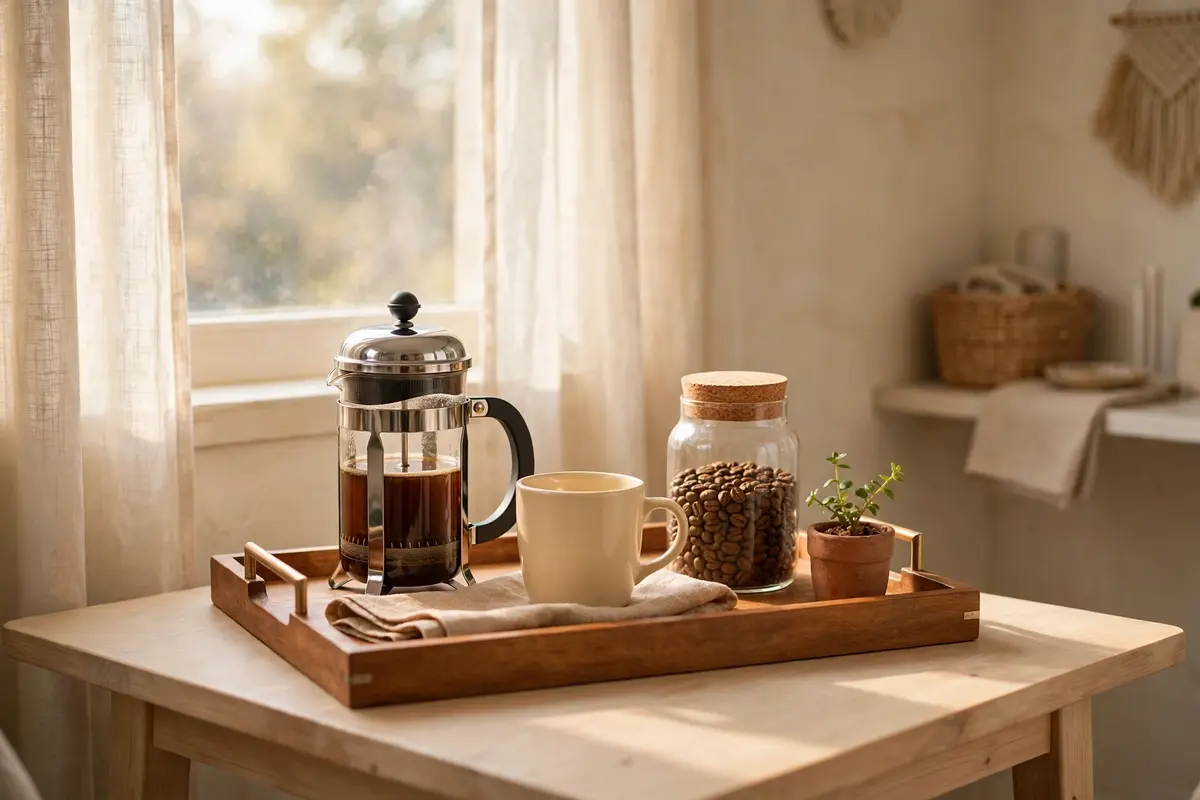
3. Create a Pack-Away Station on a Sturdy Tray
If you have no place to park a cart, keep your everyday coffee supplies together on a sturdy tray. When you want coffee, move the tray to a suitable table or desk; when finished, return it to a shelf or cabinet.
A tray helps organize small items and may catch minor drips, but it is not a substitute for a stable, heat-suitable brewing surface. If the table is too small or wobbly, use a sturdy folding table designed to support the appliance. Do not balance a hot-water machine on a step stool or an unstable stand.
Tray and Surface Stations
4. Make a One-Tray Coffee Station
A single tray can group a French press or compact brewer, two mugs, a spoon, and a small jar of coffee. Use a dining table corner, sideboard, or desk only when that surface is stable and can safely support the equipment.
Choose a tray with raised edges if you want to contain small drips, and keep it away from laptops, papers, and upholstered furniture while brewing. The advantage is flexibility: everything is grouped together and can be moved when the surface is needed for another task.

5. Use a Narrow Console Table in the Hallway or Living Room
A slim console table can keep coffee supplies outside the kitchen’s main prep area. It may fit against a living-room wall, in a suitable hallway, or beside a dining area.
Measure the table depth and preserve a clear walking path. Check outlet access before moving a coffee maker away from the kitchen. Do not run cords across a doorway or under rugs, and avoid placing the station where hot drinks could be knocked over by people passing through.
If your home already follows a cozy, low-clutter style, see How to Make a Small Living Room Cozy and Minimalist for related styling ideas.

6. Repurpose a Bookshelf Shelf or Nightstand
An existing bookshelf or nightstand can provide a coffee station without buying new furniture. Clear one shelf for the equipment and use another for mugs, filters, and sealed coffee containers.
Check the shelf’s load rating, depth, and height. Leave enough space to open the brewer and remove its reservoir fully. Keep the machine on a stable, level surface and avoid placing it on a high shelf where filling or lifting a hot pot would be awkward.
Hidden Coffee Stations

7. Store the Station in a Cabinet or Pantry Shelf
A deep cabinet or pantry shelf can keep coffee supplies out of sight. Store mugs, filters, beans, and other accessories together so the setup is easy to retrieve.
Do not assume that a cabinet is a safe place to operate the machine. Unless the appliance’s instructions explicitly allow cabinet operation, take it out before brewing and use it on a suitable open surface. Steam and heat can damage cabinet finishes and create hidden moisture.
If there is no suitable outlet nearby, keep the cabinet for storage and brew at a safe, stable table or counter.
8. Use the Space Under an Existing Counter or Kitchen Cart
The area beneath a kitchen cart, baker’s rack, or open console may fit a pull-out shelf for storing coffee equipment. This is most useful for low-profile appliances or manual brewing tools.
If you plan to brew on a pull-out board, ensure the board and furniture are specifically sturdy enough to support the machine and that the appliance has the required open space around it. Do not run a steam-producing appliance inside a confined cubby. Pull the equipment into an open, stable position before use unless the manufacturer permits the proposed setup.

9. Repurpose a Laundry or Utility Cart
A spare utility cart can become a coffee station if it is clean, stable, and suitable for the equipment. Give the cart a dedicated role rather than mixing coffee items with laundry detergent, cleaning products, or other chemicals.
Keep the machine on a level top, put heavier supplies lower down, and check that the wheels lock. Store the cart where it will not block a doorway, washing machine, or walkway. If you are organizing other compact household systems, see Small Laundry Area Organization Ideas for related ideas.
No-Drill Vertical Storage
10. Use a Mug Tree and Tiered Stand
A freestanding mug tree keeps cups within reach without attaching a rack to the wall. A tiered organizer can hold lightweight coffee pods, filters, tea bags, and small accessories on a cart or console.
Check that the base is stable and that hanging mugs cannot bump into the coffee maker. Keep heavy jars and bottles on a secure lower shelf rather than on a narrow top tier.
11. Add Over-Door or Adhesive Storage for Lightweight Supplies
An over-door organizer can hold filters, pod packets, tea bags, and other light supplies. Adhesive organizers may work on suitable smooth surfaces, but the surface, product rating, curing time, and exposure to heat or steam all matter.
Follow the product instructions and do not load adhesive hooks with heavy mugs or bottles unless they are explicitly rated for that use. Keep organizers away from steam paths and make sure an over-door unit does not prevent the door from closing.
12. Choose a Freestanding Tiered Organizer Instead of a Tension-Rod Shelf
A small freestanding tiered stand can create vertical storage for filters, pods, and sealed coffee jars without drilling. Place it beside the machine or on a cart where it cannot be knocked over.
Avoid putting a makeshift tension-rod shelf above a hot appliance. A loose or overloaded shelf could drop items onto the machine. Keep storage lightweight, stable, and away from heat and steam.
Choosing the Right Coffee-Making Setup
13. Choose a Compact Single-Serve Brewer
A compact single-serve machine may suit a small station, but machines vary in width, depth, height, and how their lids or reservoirs open. Measure the exact model in its ready-to-use position rather than assuming all single-serve brewers fit the same footprint.
Check that you can fill the reservoir, place a mug, and remove used pods without moving the machine into an unsafe position. A side-access reservoir may suit one layout better than a top-opening design.
14. Use a French Press, Moka Pot, or Pour-Over Setup
A manual coffee method can reduce the amount of equipment you need to store. A French press, pour-over cone, or moka pot may take less storage space than a full electric brewer, depending on the rest of your setup.
If you use an electric kettle or stovetop, follow its safety instructions and keep hot water away from the edge of the table. Let hot equipment cool before packing it away, and store it where it cannot spill onto electronics or fabrics.
15. Choose One Multi-Function Appliance Instead of Several Gadgets
A machine that combines brewing and another function may reduce the number of items you need to store. But a larger all-in-one appliance is not automatically smaller, so compare its complete footprint and access requirements with the separate devices it would replace.
Before buying another gadget, list what you already use. A compact station works best when each item has a clear purpose and can be stored safely.
What Not to Do in a Small Apartment Coffee Station
- Do not permanently occupy your only prep counter if a tray or cart could serve the same purpose and be moved away.
- Do not operate a steam-producing machine inside a closed cabinet. Follow the manufacturer’s clearance and ventilation instructions.
- Do not overload a cart’s top tier. Confirm the rated load, use a level surface, lock the wheels, and keep heavier items low.
- Do not place power strips where water can reach them. Keep cords away from sinks, spills, wheels, and foot traffic.
- Do not rely on adhesive hooks for heavy mugs or bottles unless the product is specifically rated for that load and surface.
- Do not buy furniture before measuring. Check the full machine dimensions, lid and reservoir opening, mug space, outlet position, and walking clearance.
Which Coffee Station Is Right for You?
- For a studio apartment: choose a tray station or a compact cart that can be stored when not in use.
- For renters who cannot drill: start with a freestanding cart, tray, mug tree, or tiered organizer.
- For a shared kitchen: use a portable tray or cart so your supplies stay together and can be moved.
- For an espresso machine: prioritize a sturdy, level surface, safe outlet access, and the clearances specified by the manufacturer.
- For the lowest-cost setup: begin with equipment and furniture you already own, such as a French press, a tray, and a shelf.
Frequently Asked Questions
How much space do I need for a coffee station?
It depends on the machine and the brewing method. Measure the appliance’s width, depth, and height, including space needed to open the lid or remove the reservoir. Leave room for a mug and for safe use, and check the manufacturer’s instructions for heat and steam clearance.
Can renters create a coffee station without drilling?
Yes. A rolling cart, tray, existing bookshelf, nightstand, or freestanding organizer can create a dedicated coffee zone without permanent holes. Check stability, load ratings, and appliance clearance before using the setup.
Where is the best place for a coffee station in a small apartment?
Choose a location that does not block food preparation or walking paths. A cart can park in a suitable corner, a console can work in a living room, and a tray can be stored away between uses. Make sure the location has safe outlet access and meets the appliance’s instructions.
Can I keep a coffee maker inside a cabinet?
You can often store the machine and supplies in a cabinet, but you should not operate it there unless the manufacturer’s instructions explicitly permit it. Heat and steam can damage cabinet surfaces. When in doubt, remove the machine before brewing.
What is the cheapest small coffee station setup?
Use equipment and furniture you already have: a French press or pour-over, a sturdy tray, a mug, and a shelf or table. Avoid buying a dedicated cart until you know where it will fit and how often you need to move it.
The Bottom Line
A coffee station is not necessarily a countertop. A cart, tray, console table, existing shelf, or portable brewing setup can keep your coffee essentials organized while leaving the kitchen prep area free.
Measure first, choose a stable surface, follow the machine’s instructions for heat and steam, and keep cords away from water and walkways. The best station is the one that fits your apartment and your routine—not the one with the most accessories.
For more small-space ideas, explore Under-Sink Organization for Small Rental Kitchens and How to Store Cleaning Supplies in a Small Apartment.