
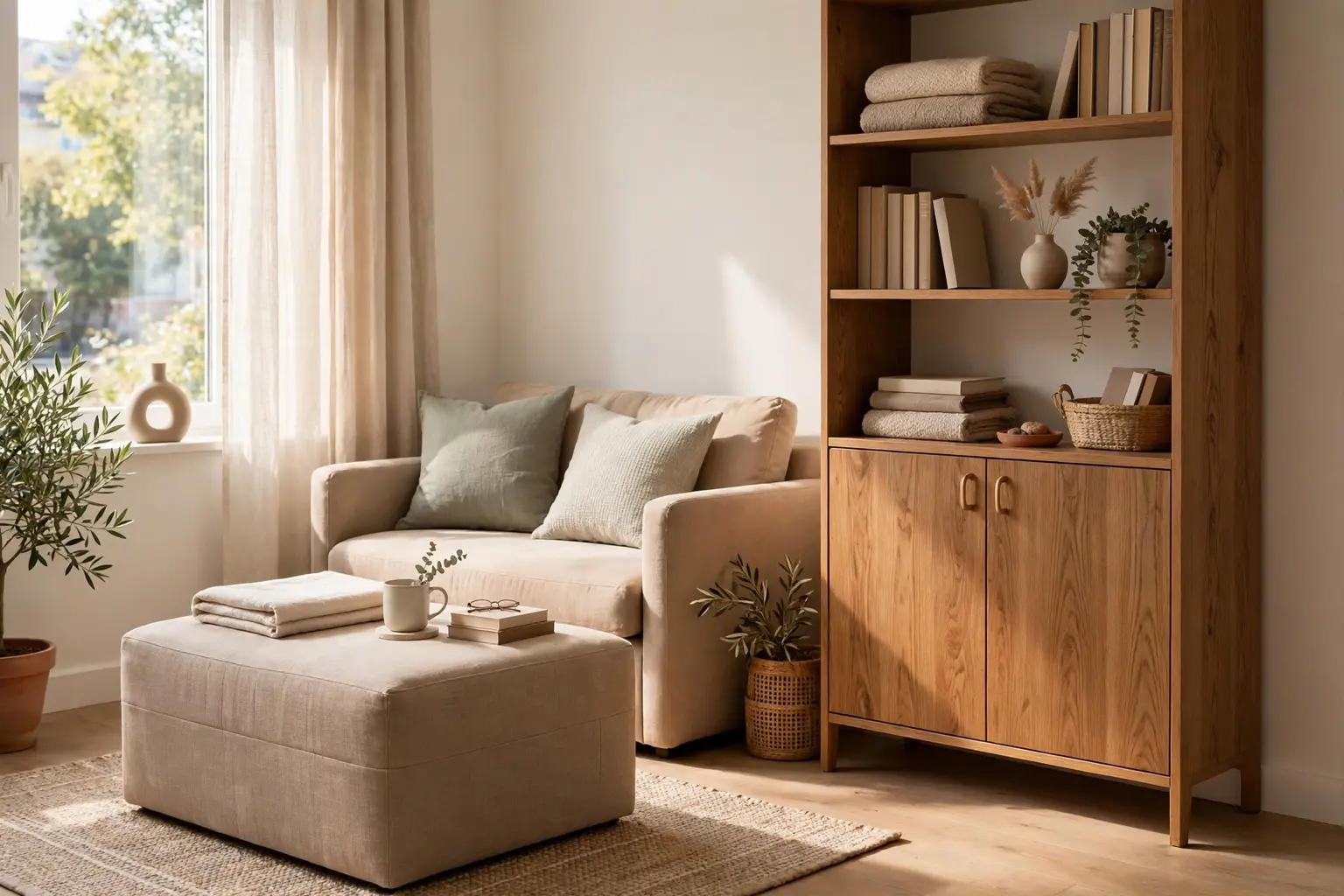
Small apartments often have the same storage problem: everyday essentials are easy to see, but less attractive household items have nowhere to go. Chargers, spare supplies, off-season clothes, and miscellaneous belongings can quickly take over chairs, countertops, and open shelves.
Buying more storage is not always the answer. Sometimes, the better solution is to make existing furniture and unused spaces work harder.
A storage ottoman, an under-bed drawer, a suitable door rack, or a closed bookcase can help keep everyday clutter out of sight without making a room feel crowded.
The following 11 hidden storage ideas focus on practical furniture, overlooked spaces, and simple ways to keep a small apartment looking organized. Some options require no installation, while wall-mounted shelves and other fixtures may require drilling and landlord permission.
Before You Buy Anything: The Ten-Minute Storage Audit
Start with a quick walk through your apartment rather than a shopping list.
Look for spaces that are currently unused or poorly organized:
- Under the bed and other raised furniture.
- Behind bedroom and closet doors.
- Inside kitchen and bathroom cabinet doors.
- Above doorways.
- Beside refrigerators and wardrobes.
- Under entryway benches.
- Inside furniture with unused compartments.
Measure the available space before choosing any organizer. Check door swing, walking clearance, furniture dimensions, and access to electrical outlets and appliance ventilation.
Next, decide which belongings actually need hidden storage.
Everyday items should remain easy to reach. Seasonal decorations, spare bedding, and occasional-use belongings can be stored farther away or higher up, provided they remain safely accessible.
One useful principle is to replace rather than simply add. If a coffee table has no storage, consider replacing it with a lift-top model instead of introducing another piece of furniture.
The goal is to create useful storage without filling every available space.
Inside Furniture You Already Own (or Would Buy Anyway)
Furniture with built-in compartments can provide storage without adding separate cabinets or boxes.
1. Choose a Lift-Top Ottoman or Storage Bench
A lift-top ottoman can provide a place to store blankets, board games, and other lightweight living-room belongings.
A storage bench near the entrance can serve a similar purpose for suitable everyday items such as bags, scarves, and accessories.
When the lid is closed, the furniture looks like a regular seating or decorative piece rather than a storage container.
Before buying, check:
- The manufacturer's recommended weight capacity.
- Whether the lid and hinges are designed for regular use.
- Whether the lid stays open safely when needed.
- Whether the furniture fits the available floor space.
Avoid overloading the compartment or storing plugged-in chargers and electrical equipment inside an enclosed ottoman.
2. Use a Lift-Top Coffee Table
A lift-top coffee table offers a useful compartment for remotes, notebooks, magazines, and small household accessories.
It also provides a convenient work surface when the top is raised, making it useful in apartments where a separate desk may not fit.
Choose a model with a stable lifting mechanism and enough clearance for the top to open without hitting the sofa or nearby furniture.
Follow the manufacturer's weight limits. Keep heavy objects away from the moving mechanism and avoid placing drinks where they could spill into the compartment.
3. Add a Storage Headboard
A storage headboard can make use of the space behind your bed.
Look for a design with enclosed compartments, drawers, or a combination of shelves and closed storage. These can hold books, glasses, small personal belongings, and other bedroom essentials.
If you rent and cannot drill into the wall, consider a freestanding headboard designed to stand securely behind the bed.
Check its stability and follow the manufacturer's assembly and securing instructions. Tall furniture should be properly anchored when required to reduce tip-over risks.
4. Use Drawers or Rolling Bins Under the Bed
The space underneath a raised bed can provide useful storage for belongings that do not need daily access.
Built-in bed drawers are suitable for spare bedding and off-season clothes. Flat rolling containers can provide a similar solution under a regular bed frame.
Before purchasing anything, measure:
- The clearance between the floor and bed frame.
- The usable width and length.
- The space needed to pull drawers or bins out.
- Any nearby heating vents or other obstructions.
Choose containers that are easy to access and keep their contents clean and dry.
Avoid blocking heating or ventilation openings, and do not overload drawers beyond the manufacturer's recommended limits.

Behind Doors: Make Use of Unused Space
The back of a door can provide storage without taking up additional floor space. The important thing is to choose suitable products and avoid putting excessive weight on doors or hinges.
5. Install an Over-the-Door Rack or Hooks
Over-the-door racks and hooks can hold coats, bags, belts, scarves, and other lightweight accessories.
They are particularly useful in bedrooms, closets, and entryways where wall space is limited.
Before installing one:
- Check the door thickness and rack compatibility.
- Confirm the manufacturer's weight limit.
- Make sure the door closes completely.
- Check that hanging items do not obstruct the walking route.
- Avoid overloading the rack with heavy objects.
If a rack interferes with normal door operation, choose another location rather than forcing the door closed.
6. Organize the Inside of Cabinet Doors
The inside of a cabinet door can hold small accessories that would otherwise take up shelf space.
Depending on the cabinet and the mounting system, suitable items might include lightweight kitchen accessories, small bathroom supplies, or household organizers.
Keep the load within the cabinet manufacturer's recommendations. Excessive weight can strain hinges and prevent the door from closing properly.
For adhesive racks, follow the exact manufacturer's surface preparation, application, and weight-limit instructions.
For example, Command states that its products should be applied to suitable, smooth, clean surfaces, and painted walls should be fully cured for at least seven days. This guidance applies to the specified Command products, not every adhesive product.
Avoid using products on wallpaper, heavily textured surfaces, or weak paint unless the manufacturer specifically approves that surface.
official Command product guidance
Above Eye Level: Use High Storage Carefully
Higher storage can be useful for belongings that are not needed every day. However, anything mounted above head height must be properly secured and kept within its recommended load limit.
7. Add a Shelf Above a Doorway
The wall above a doorway can provide additional storage for lightweight belongings such as spare linens, seasonal decorations, or infrequently used accessories.
A shallow shelf can make use of this otherwise unused area without taking up floor space.
Unlike a freestanding organizer, an above-door shelf generally needs a suitable wall-mounting system. This may involve drilling, so check your rental agreement and obtain permission where necessary.
For a safe installation:
- Choose fixings suitable for your wall type.
- Follow the shelf manufacturer's installation instructions.
- Observe the stated weight capacity.
- Store only lightweight, stable items.
- Avoid placing loose objects where they could fall into the doorway.
If installation is not permitted, skip this option and use a freestanding storage alternative.

8. Create a High Storage Zone with Matching Bins
A properly installed high shelf can hold spare linens, seasonal accessories, and other lightweight belongings.
Matching storage bins can make the arrangement look more consistent and help prevent loose items from becoming visually distracting.
Choose bins that fit the shelf dimensions and have secure lids where appropriate. Add clear labels facing outward so you can identify their contents without opening every container.
Keep heavier belongings on lower shelves. High shelves should not become a place for heavy boxes, glass containers, or frequently handled items.
If you use tall bookcases or shelving units, secure them according to the manufacturer's instructions. The US Consumer Product Safety Commission recommends anchoring bookcases and other heavy furniture to reduce tip-over risks.
CPSC furniture safety guidance
Dead Corners and Unused Gaps
Small apartments often contain narrow spaces that are difficult to use with conventional furniture. The right organizer can turn these areas into functional storage.
9. Place a Slim Rolling Cart in an Unused Gap
A slim rolling cart can fit beside a wardrobe, between suitable furniture, or in an unused kitchen area.
It works well for lightweight household supplies, accessories, and other belongings that need to remain accessible.
Measure the available gap before buying. Include enough clearance to pull the cart out and move it safely.
Keep these points in mind:
- Do not block doorways or walking routes.
- Preserve the ventilation clearance required by nearby appliances.
- Keep the heaviest items on the lowest shelf.
- Lock the wheels whenever the cart is parked.
- Follow the manufacturer's assembly and weight-limit instructions.
A rolling cart should remain stable and easy to move. If the available gap is too narrow, a different storage option may be more practical.
10. Use Corner Shelves and Under-Bench Baskets
Corners and the space underneath benches can provide useful storage without requiring another large cabinet.
A corner shelving unit can hold decorative items or frequently used belongings, while suitable baskets underneath an entryway bench can organize shoes, bags, and accessories.
Choose baskets that fit completely beneath the bench and can be pulled out without obstructing the walkway.
For corner shelving:
- Check the unit's stability and weight capacity.
- Keep heavier objects on lower shelves.
- Secure tall units according to manufacturer instructions.
- Check whether wall mounting is permitted in your rental.
Matching baskets can help the area look coordinated without requiring every item to be hidden.
Make Closed Storage Look Like Part of the Room
11. Choose a Bookcase with Closed Lower Storage
Open shelving is useful for displaying books, plants, and decorative objects, but it can also make a small room look crowded when every shelf is full.
A bookcase with closed lower doors provides a practical balance.
Use the open upper shelves for a few carefully selected items, and keep less attractive belongings in the lower compartments.
You can also use matching storage bins inside open shelving if the bookcase does not have doors.
Before purchasing, measure the available wall space and check the bookcase's dimensions, assembly requirements, and weight capacity.
If the bookcase is tall, anchor it according to the manufacturer's instructions. Do not assume that a heavy unit is stable simply because it is placed against a wall.
A Note About Cables and Electrical Equipment
Cable management can make a small apartment look considerably tidier, but electrical equipment should never be hidden in a way that creates a safety problem.
A purpose-designed cable organizer may help manage loose cords, but:
- Keep ventilation openings on electronic devices unobstructed.
- Do not enclose routers, chargers, or powered equipment unless the manufacturer permits that type of installation.
- Do not overload power strips or extension cords.
- Avoid connecting one extension lead or power strip to another.
- Keep cables away from liquids, heat sources, and walking routes.
- Follow the electrical equipment manufacturer's instructions.
A tidy cable arrangement should make equipment safer and easier to access, not simply hide it from view.
For additional information, see the Electrical Safety Foundation International’s extension cord guidance.
How to Keep Hidden Storage Organized
Hidden storage is useful only when you can still find what you need.
A closed box can easily become a place where miscellaneous belongings accumulate. A simple maintenance routine helps prevent that.
Try these habits:
- Label closed containers and keep labels visible.
- Return belongings to their assigned storage areas after use.
- Review seasonal storage when the season changes.
- Check for damaged containers, moisture, or items that need attention.
- Reorganize areas that have become difficult to access.
Twice a year, review what you have stored. Consider whether each item is still useful, whether it is seasonal or needed for emergencies, and whether it should be kept, donated, recycled, or discarded.
There is no need to remove something simply because you have not used it during the past year. The important thing is to avoid keeping unnecessary belongings that make everyday storage difficult.
Hidden Storage Is Only Useful If You Can Retrieve It
Use this selection test: first, name the items and how often you need them. Second, measure the storage cavity, opening and removal path. Third, check the retrieval penalty — whether the solution takes more floor space than it saves, or hides items behind furniture you must move first. Finally, compare cost, stability and upkeep.
Illustrative comparison: a bed has 7 inches of clear space from the floor to its lowest obstruction. A box advertised as 7 inches tall may fail once wheels, handles or a raised lid are included. Measure the box’s complete outer height and the route needed to slide it out.
Choose by frequency: daily-use belongings should stay readily accessible; occasional linens can live in deeper storage; sentimental or fragile objects need dry, protective conditions rather than an inconvenient loose pile. Avoid storage that blocks electrical outlets, vents, exit routes or furniture anchoring.
Check whether a real container fits with the Bin-Fit Calculator, and before buying a large piece, check that it fits through the door with the Furniture & Doorway Calculator. For closet overflow, see our small closet storage guide. A hidden storage system should reduce visible clutter and keep access simple.
Do vacuum bags create more actual storage capacity?
They can reduce the volume of suitable textiles, but not the size of the container or the available opening. Follow fabric-care advice and avoid compressing items that could be damaged.
Quick Questions
Do I need to buy new furniture to create hidden storage?
No. Start with spaces and furniture you already have.
The back of a door, a suitable cabinet compartment, or a set of matching bins may provide enough additional storage. Replace existing furniture only when a storage-focused alternative genuinely solves a space problem.
Are adhesive hooks and racks suitable for renters?
Some adhesive products can be suitable for renters, but compatibility depends on the exact product and surface.
Check the manufacturer's approved surfaces, weight limits, preparation instructions, and removal guidance. Do not assume that an adhesive product will work on every painted wall or textured surface.
How can I prevent hidden storage from becoming forgotten storage?
Use labels, keep everyday belongings within easy reach, and review seasonal containers periodically.
Avoid putting frequently used items in places that require moving several other objects to access them.
What if my apartment has no under-bed clearance or unused furniture gaps?
You do not need to use every idea in this guide.
Consider door-back organizers, cabinet-door racks, suitable closed bookcases, or furniture with built-in storage. Choose only the options that fit your actual apartment.
Related Guides
- Small Closet Storage for Renters: Practical ways to organize closet space and manage belongings without permanent changes.
- Small Apartment Entryway Ideas When You Don't Have a Closet: Explore benches, door storage, and compact entryway organization.
- 15 Small Apartment Pantry Ideas When You Don't Have a Pantry: Discover ways to organize kitchen food storage using existing space.