
By Kamran
A small apartment can get messy quickly when the kitchen, living area, and workspace share the same room. A few dishes or a pile of laundry can take over the space you need for something else.
This schedule combines a short daily reset with one focused cleaning area on most days. Allow roughly 15 minutes for the reset and another 20 minutes for the day’s zone: about 35 minutes in total. These are planning estimates, not deadlines. The first clean may take longer, especially if you’re starting with clutter or built-up grime.
Start with the weekly table, move the days around to suit your routine, and download the free checklist in US Letter or A4. On a busy day, do the essentials and leave the rest.
The week at a glance
| Day | Focus | Approx. time |
|---|---|---|
| Monday | Kitchen | About 35 minutes |
| Tuesday | Bathroom | About 35 minutes |
| Wednesday | Floors throughout the apartment | About 35 minutes |
| Thursday | Bedroom | About 35 minutes |
| Friday | Living area | About 35 minutes |
| Saturday | Laundry and linens | About 45 minutes hands-on, plus machine time and any travel |
| Sunday | Catch up or rest | About 15 minutes for the reset; an optional 20-minute catch-up |
All times include the 15-minute daily reset. Saturday allows about 30 minutes of laundry work plus the reset; the number of loads and your drying arrangements will change that estimate. Monthly tasks are extra and can be spread out.
If 35 minutes is more than you have, split the work into shorter sessions or choose fewer tasks. You don’t need to finish a whole room for the effort to count.
Before you start
Follow the labels on cleaning products and the care instructions for appliances, fixtures, and floors. Never mix cleaning products, especially bleach with acids or ammonia. Ventilate as directed and keep products in their original labelled containers, out of reach of children and pets.
Cleaning removes dirt and grime; disinfecting is a separate step. CDC guidance explains that routine cleaning is generally enough in many everyday household situations. If disinfection is needed, clean first and follow the disinfectant’s label, including the required contact time.
Your 15-minute daily reset
Pick a time that fits your day. After dinner may be convenient, but mornings or a few short sessions can work too.
- Deal with dishes and food mess. Wash essential dishes or load the dishwasher. Without a dishwasher, smaller batches may be easier than tackling everything at night.
- Wipe food-preparation surfaces. Use a cleaner suitable for the surface. Wipe stovetop spills once it has cooled, following the appliance’s instructions.
- Put things away for five minutes. Start with a counter, table, or chair you need to use. Stop when the timer ends.
- Check the bins. Empty them when full, leaking, or causing odors; food waste may need attention before a bin is full.
- Make the bed if it helps you feel settled. This is optional, especially on a low-energy day.
- Check the bathroom. Wipe a dirty sink or deal with a spill if needed. Leave the detailed cleaning for bathroom day.
Fifteen minutes is a useful starting point, not a guarantee. On a difficult day, focus on food mess, essential dishes, and spills. The bed and scattered books can wait.
Only have five minutes?
Do this: clear food mess and wash the essential dishes, wipe the stovetop once it’s cool, and take out anything starting to smell. Skip everything else without guilt — the full reset will still be there tomorrow.
Monday: get the kitchen ready for the week
The kitchen sets the tone for the week — start here and the rest feels easier.
- Check the fridge for spoiled food and leftovers that need attention.
- Wipe cabinet handles and any marked cabinet fronts, then clean the sink and faucet with suitable products.
- For dried food in the microwave, follow its cleaning instructions. Steam can loosen residue, but water quantities and heating times depend on the appliance. GE’s cleaning guidance provides one manufacturer-specific method. Use a microwave-safe container, allow the recommended standing time, and handle hot water and steam carefully before wiping the interior.
- Wipe stovetop spills once the surface has cooled, following the appliance’s instructions.
- Spot-clean floor spills as needed. Save the full floor clean for Wednesday.
Tip: if the fridge clean-out feels big, do one shelf. It still counts.
Tuesday: give the bathroom a proper clean
Bathrooms go smoother with compatible products and a top-to-bottom order.
- Remove loose dust and hair first, then work downward: mirror, shelves, shower or tub, sink and vanity, toilet.
- Apply the appropriate cleaner to one area at a time according to its label. Leave it for the specified time only where instructed, then wipe or rinse as directed. Never mix cleaning products.
- Use separate cloths for the toilet and other surfaces, and use a toilet brush for the bowl.
- Replace towels or the bath mat if they need washing, empty the bin, and spot-clean the floor as needed. If the bathroom floor needs a full clean today, do it and skip that floor on Wednesday.
Tip: spray cleaners first and let them sit while you do other tasks — but only for the time stated on the product label.
Wednesday: wall-to-wall floors
This is the week’s one full floor session. On other days, just handle spills and visible dirt.
- Clear enough floor space to work, then vacuum or sweep up loose dirt before mopping. Include accessible furniture edges and the entryway.
- Mop only surfaces suitable for wet cleaning, using the product and moisture level recommended by the flooring manufacturer. Avoid excess water; don’t use a steam mop unless the floor’s care instructions permit it.
- Clean small rugs and doormats according to their care labels. In an apartment building, avoid shaking debris onto another balcony or into shared areas.
Tip: always vacuum before mopping — mopping over grit just spreads it around.
Thursday: clear the bedside clutter
Keep this day focused. It’s about rest, not projects.
- Change sheets when due, or leave this for your laundry day.
- Dust the nightstand and accessible shelves.
- Choose one small surface or drawer to put in order. Emptying the whole wardrobe can turn a short session into something you don’t have time to finish.
- Spot-clean the floor only if needed.
Tip: set a timer for the drawer — ten minutes keeps it a task, not a project.
Friday: reset the living room
End the week with the room you spend the most time in.
- Dust accessible shelves, picture frames, and the TV stand.
- Clean switches and handles using suitable methods without spraying liquid into electrical fittings. Follow the manufacturer’s guidance for screens and other electronics.
- Put away items that belong elsewhere. Fold blankets and vacuum sofa cushions if needed and permitted by the upholstery instructions.
- If this room is also your workspace, clear and wipe the desk.
- For a studio apartment, combine this with Thursday’s session so you aren’t cleaning the same space twice.
Tip: keep a small basket for strays — collecting first and putting away second is faster than carrying each item individually.
Saturday: laundry and fresh sheets
One full cycle a week keeps bedding and towels from becoming their own project.
- Choose a regular laundry slot and adjust the number of loads to your household.
- Hands-on work — sorting, loading, transferring or hanging, folding, putting away — takes about 30 minutes. Machine cycles and laundromat travel are additional.
- With shared facilities, plan linen changes around access to the machines. Keep a spare set of bedding if your budget and storage allow, so a delayed load doesn’t leave you without sheets.
- Follow fabric labels and machine instructions. If several loads are waiting, choose the items you need first rather than treating the entire pile as one task.
Tip: fold straight from the dryer or line — clothes put away immediately never become the chair pile.
Sunday: catch up—or take the day off
- If something important was missed, choose one task for a short catch-up. Otherwise, rest.
- Move next week’s sessions around appointments, work, or laundry access.
- Missed the reset too? Restart when you can. There is no cleaning debt to repay before you can begin again.
Tip: use two minutes to glance at next week — that’s the entire planning burden.
Missed a day?
Don’t try to catch up on everything. Restart with the highest-priority task — usually the daily reset first, then the kitchen or bathroom. Let the rest roll to next week.
Monthly tasks: choose what needs attention
Use this as a reminder list, not a requirement to complete every job on the same day or at exactly monthly intervals:
- Dust accessible fan blades, vent covers, and cabinet tops.
- Wipe baseboards a section at a time.
- Clean accessible interior window glass.
- Descale a kettle or coffee maker when needed, following its instructions.
- Clean under the bed and behind furniture you can move safely.
- Vacuum the mattress if its care instructions allow it.
- Choose one appliance that needs a deeper clean.
- Sort one crowded drawer or shelf.
- Check the showerhead for mineral buildup and follow its manufacturer’s cleaning guidance. Vinegar and descalers are not suitable for every finish.
Leave building systems and repairs to the landlord or appropriate professional. Avoid climbing on unstable furniture to reach high areas.
Make the routine fit your space
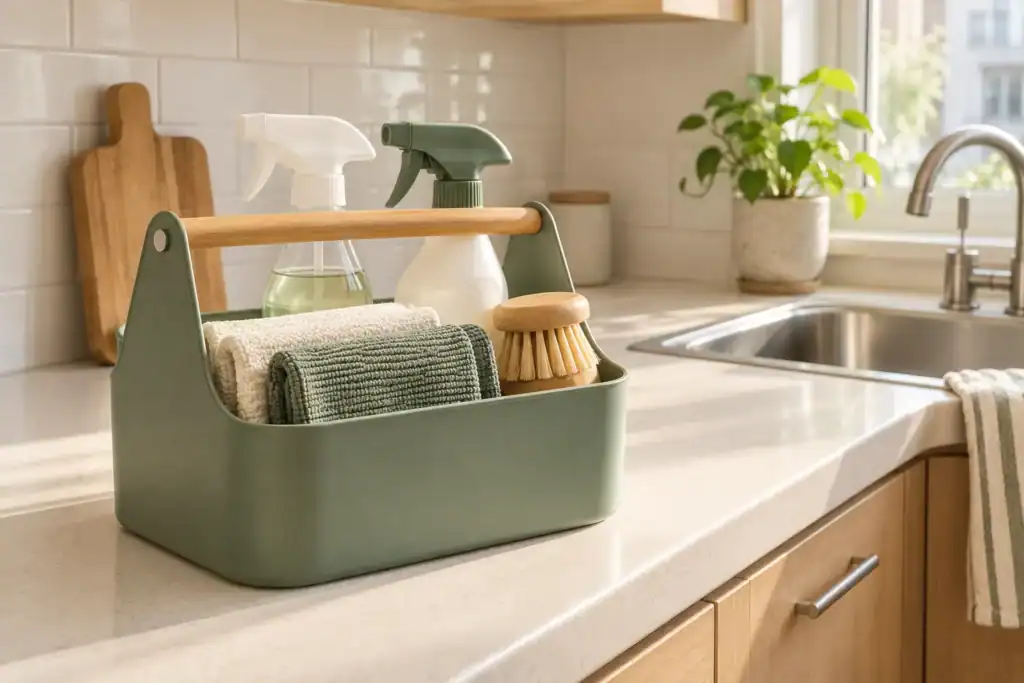
Limited storage: keep small bottles and cloths in a portable caddy. A suitable cupboard may hold the caddy, but the vacuum, mop, and broom will usually need a separate space. Check measurements before buying an organizer, and choose secure storage where children or pets could reach supplies.
Roommates: agree on who handles shared spaces and when. Rotating kitchen and bathroom duties may work better than assuming someone will notice what needs doing. Bedrooms can stay each person’s responsibility.
Low-energy weeks: split a zone into smaller tasks or spread it over several days. Cleaning the sink today and the shower tomorrow is still progress.
About this schedule
This is a suggested routine, not a timed test or a promise that every apartment takes the same amount of work. It uses familiar ideas such as dividing a home into zones and working in short sessions.
The FlyLady system is one established approach to routines and zone cleaning. Its standard zone rotation commonly focuses on one zone per week. The daily rotation here is a different arrangement intended to help readers divide a small apartment into manageable tasks.
Get the free printable
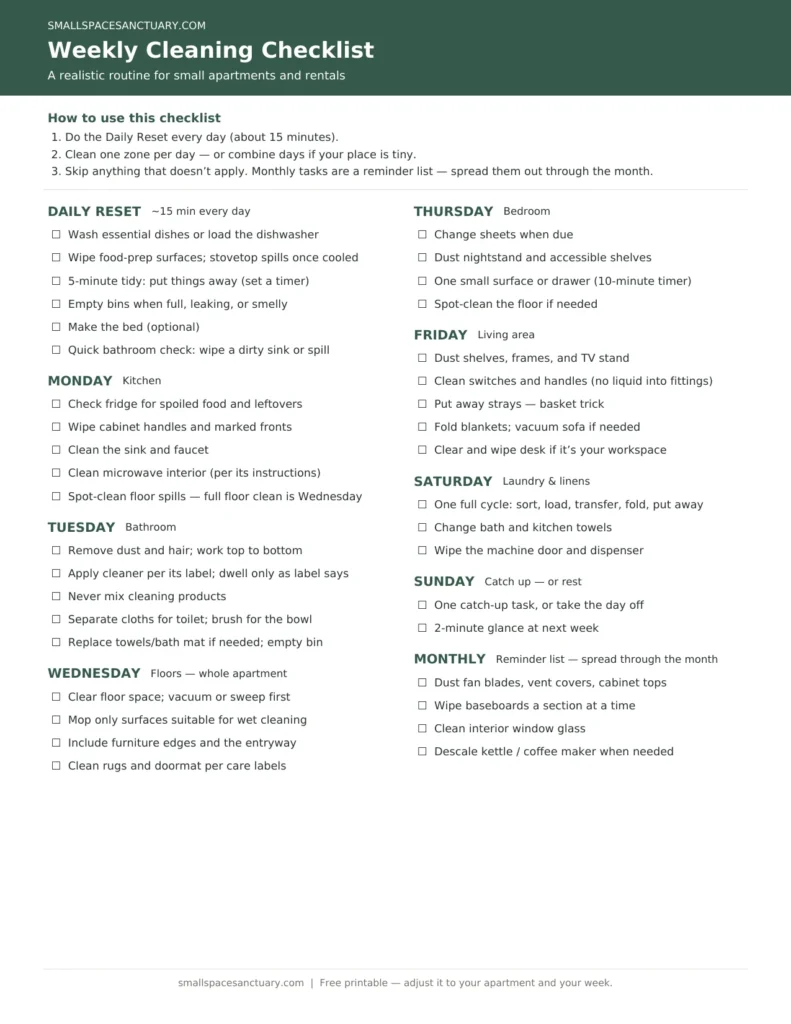
Download the weekly cleaning checklist in US Letter or A4 — no signup needed.
Move tasks to different days, cross out anything that doesn’t apply, and add the jobs your household needs. Keep the checklist somewhere useful and adjust it after you’ve tried the routine.
Explore the cleaning section or browse all free printables.